

At first, when you look at two water treatment plants, they may look almost identical from the outside. Put them on the same water source, though, and one may work well, but the other struggles within a few months.
Why does this happen? The reason is simple. A water treatment plant is not selected by appearance, tank size, or price alone. The right system depends on what is present in the raw water, how much treated water you need, and what you will use that water for.
So, if you are planning a plant for a home, apartment, office, hotel, or factory, we will walk you through the process from the beginning.
You will see how the main technologies work, which problems they address, what affects the price, and what to check before choosing a water treatment plant provider in Bangladesh. So, let’s get into it.
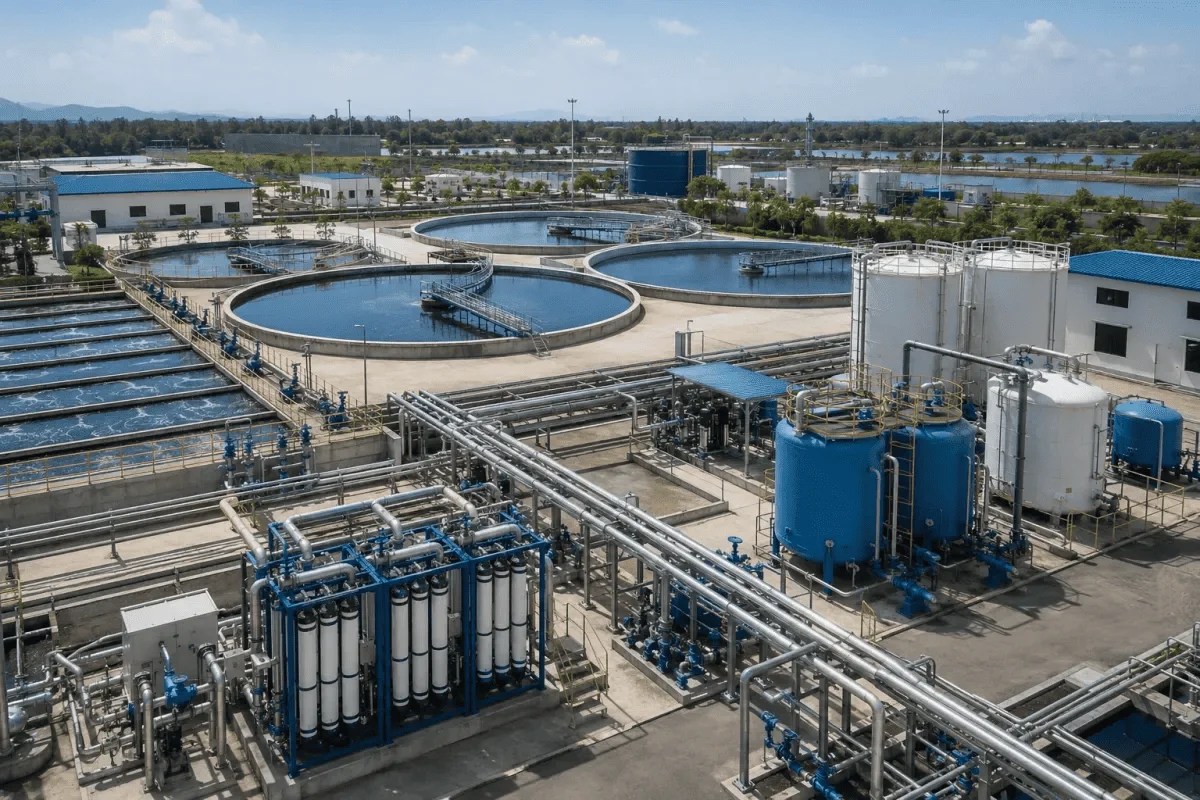
What Does a Water Treatment Plant Actually Do?
A water treatment plant takes water from a source and passes it through a planned sequence of physical, chemical, or membrane-based processes.
Each stage targets a particular problem, such as suspended dirt, iron, hardness, dissolved salts, odor, or microorganisms. The final treatment train depends on the raw water and the required use.
A complete system may contain:
- A raw-water tank and feed pump
- Aeration or chemical oxidation
- Sand, multimedia, or iron-removal filtration
- Activated carbon
- A water softener
- Cartridge filters
- Ultrafiltration or Reverse Osmosis
- UV or another disinfection stage
- A treated-water tank and distribution pump
- Backwash, regeneration, or reject-water arrangements
You do not necessarily need all of these stages. In fact, adding unnecessary equipment can increase water loss, electricity use, and maintenance costs without providing you with a useful benefit.
First, Do Not Mix Up WTP, ETP and STP
A Water Treatment Plant, or WTP, normally treats raw groundwater or surface water so it can be used for drinking, domestic work, or an industrial process.
An Effluent Treatment Plant, or ETP, treats wastewater produced by an industry.
A Sewage Treatment Plant, or STP, deals mainly with domestic sewage from buildings, hotels, hospitals, and similar facilities.
Here is the distinction you should keep in mind:
| System | Water entering the plant | Main purpose | Common locations |
| WTP | Groundwater, surface water, or another raw-water source | Produce usable, potable, or process water | Homes, buildings, factories, hospitals, and hotels |
| ETP | Industrial wastewater | Treat industry-specific pollutants before discharge or reuse | Textile, food, pharmaceutical, and manufacturing facilities |
| STP | Domestic sewage | Treat wastewater from toilets, kitchens, and building use | Apartments, hotels, hospitals, and campuses |
| WWTP | A broad wastewater stream | Treat wastewater for discharge or planned reuse | Municipal and combined facilities |
ETP and STP are related water-management systems, but they are not interchangeable types of drinking-water WTP. If your factory needs process water and also produces liquid waste, you may need two separate treatment systems with different designs.
Why Water Treatment in Bangladesh Cannot Follow One Standard Formula
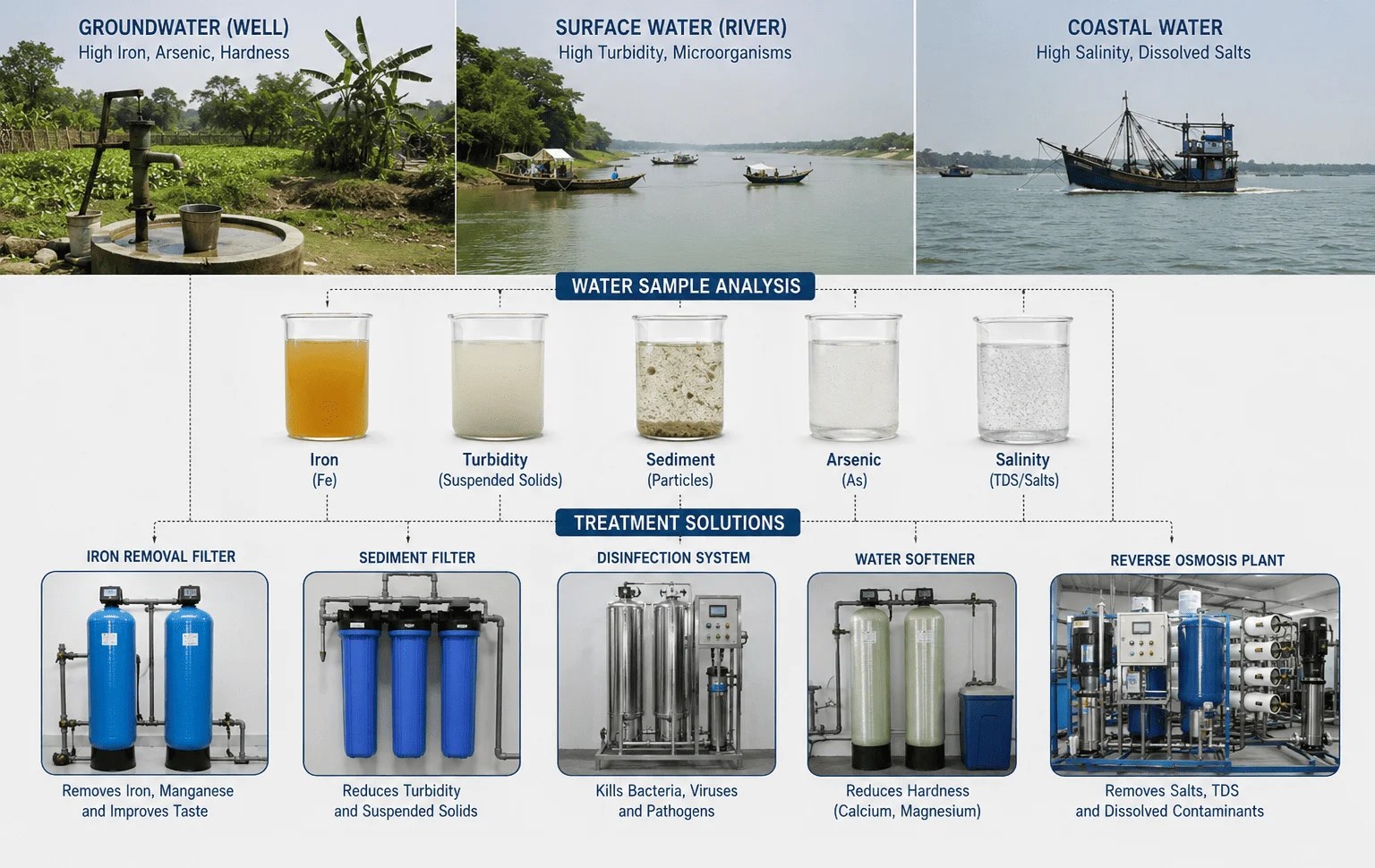
Our country does not have one uniform raw-water condition. Even two sites in the same district can produce different laboratory results.
Groundwater may carry iron, manganese, hardness, arsenic, or high dissolved salts. Coastal areas can face salinity. Surface water can change with rain, dry seasons, agricultural runoff, and nearby activities. Water supplied through a network may meet quality requirements at the source, but building tanks or internal pipes can introduce a separate problem later.
Dhaka WASA states that its central laboratory regularly tests the groundwater and surface water it supplies. That does not remove the need to assess water at the actual point of use, especially where the water passes through internal reservoirs, old pipes, or building storage systems. See Dhaka WASA’s published annual report.
The visible signs can provide clues:
- Red or orange stains: often associated with iron
- Black or dark deposits: may point to manganese or another source that needs testing
- White scale on heaters and taps: commonly associated with hardness
- Salty taste or high conductivity: may indicate a high dissolved-ion load
- Cloudiness: can result from suspended material or other causes
- Rotten-egg odor: may be linked to hydrogen sulfide or microbial activity
- Chlorine taste: may require carbon treatment, but the source should be understood first
These signs can help you identify a possible problem, but they are not a substitute for laboratory testing.
A TDS Meter Is Helpful, but It Cannot Design the Plant
A TDS meter can give you a useful indication of the overall dissolved-ion load through conductivity. But it cannot tell you exactly which ions are present.
Two water samples can show a similar TDS reading and still need very different treatment.
One sample may contain hardness minerals. Another may have more sodium and chloride. A third may contain iron as well as moderate TDS.
What should be tested?
The exact test panel depends on your source and intended application, but these parameters have a direct impact on your WTP design:
| Parameter | What it tells you | Why it changes the design |
| pH | How acidic or alkaline the water is | Influences corrosion, oxidation, and treatment chemistry |
| Turbidity | The level of cloudiness or suspended matter | Affects clarification, filtration, and disinfection |
| TDS or conductivity | The overall dissolved-ion load | Helps assess membrane or demineralization needs |
| Iron | The concentration of iron in the source | Shapes oxidation, media, and backwash requirements |
| Manganese | The concentration of manganese | May require different oxidation conditions or media |
| Hardness | Calcium and magnesium load | Determines softener capacity and salt use |
| Arsenic | A serious chemical risk where present | Requires a validated removal process and treated-water verification |
| Chloride or salinity | Salt-related load | Influences RO design, recovery, and material choice |
| Coliform or E. coli indicators | Possible microbiological contamination | Shapes disinfection and hygiene controls |
Depending on the project, the laboratory may also need to examine alkalinity, silica, ammonia, nitrate, fluoride, heavy metals, or industry-specific substances.
So, you shouldn’t buy the equipment before the water report. The water report should come first.
Take the Sample From the Right Place
Even a detailed laboratory analysis can mislead you if the sample does not represent the water your plant will actually treat.
For a new system, collect the raw-water sample before any existing treatment equipment. Follow the laboratory’s recommended container and sampling procedure.
If your water source changes significantly between wet and dry seasons, you should also consider whether a single sample represents the full range of conditions your plant will face.
How the Water Treatment Process Works
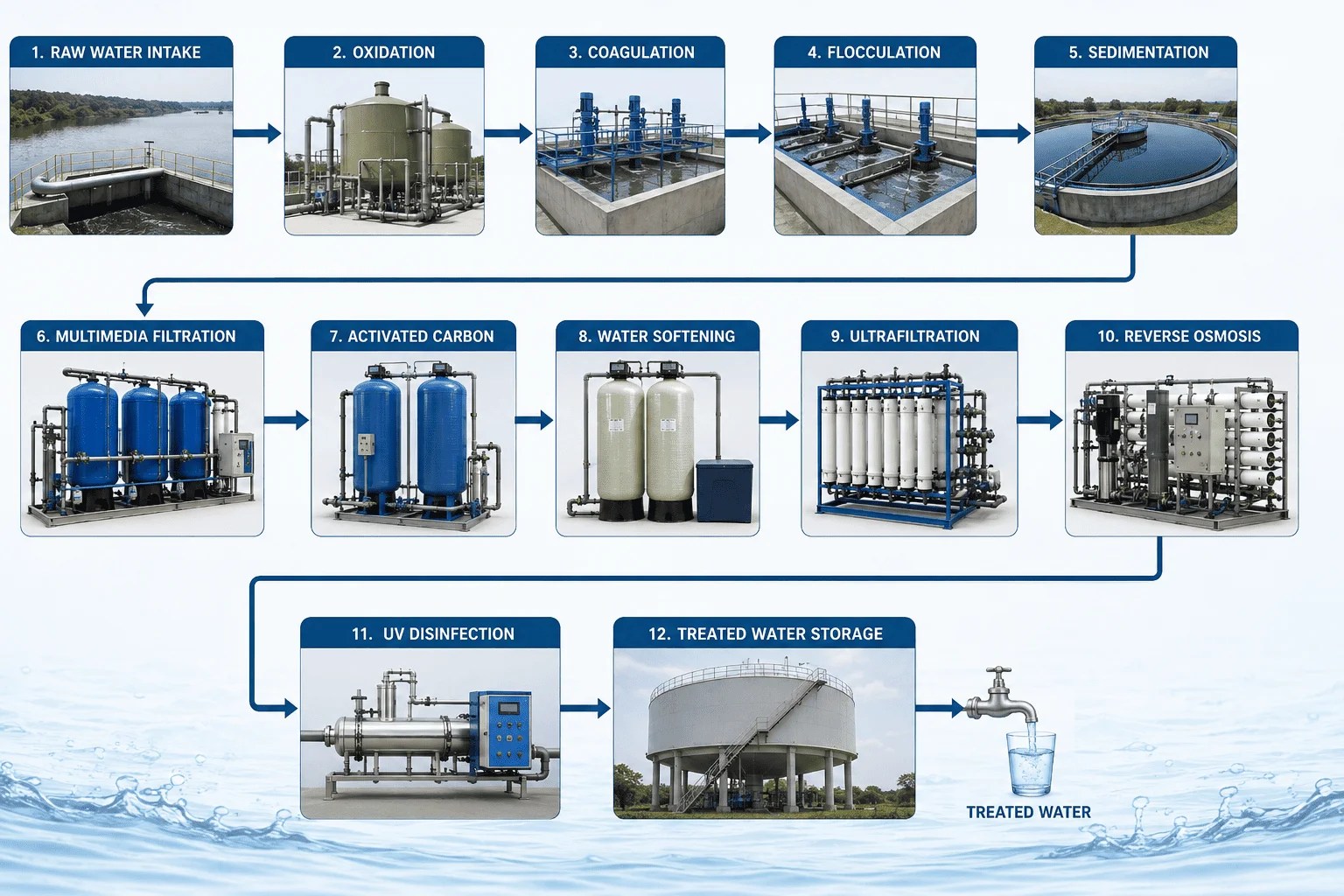
There is no fixed seven-stage or ten-stage formula for every WTP. Still, the main processes are easy to understand once you see what each one is supposed to do.
Intake and screening remove the larger material
Surface-water systems may begin with screens that stop leaves, debris, and larger solids. Groundwater normally needs a different starting arrangement, but a raw-water tank and feed pump are common parts of many systems.
Aeration or oxidation changes difficult contaminants into a filterable form
Dissolved iron may pass through water without being caught effectively by a simple sediment filter. Oxidation converts it into a form that can be retained by suitable media. Air, chlorine, or another oxidant may be used depending on the water chemistry and process design.
This step is not “more air means better treatment.” Contact time, pH, iron form, manganese, and the following filter all matter.
Coagulation and flocculation gather fine particles
Very small suspended particles may not settle on their own. A coagulant destabilizes them, then gentle mixing helps them join into larger flocs. Those flocs can settle or be filtered more easily.
This sequence is common in conventional surface-water treatment. A small groundwater system may not need it.
Sedimentation lets heavier solids settle
After flocculation, the water enters a clarification or settling stage. The heavier material moves to the bottom and must be removed as sludge. The clearer water then passes to the next stage.
Multimedia filtration catches suspended matter
A multimedia filter uses layers with different particle sizes and densities. Water moves through the bed while suspended material is retained. The filter eventually needs backwashing so the trapped material does not block the bed.
Activated carbon deals with specific taste, odor, and organic compounds
Activated carbon is commonly used for chlorine reduction and the adsorption of certain organic compounds that affect taste or odor. It has a limited working capacity, though. Once the media is exhausted, keeping it in service does not provide the same performance.
Softening targets hardness
A water softener uses ion-exchange resin to exchange hardness-forming calcium and magnesium ions, commonly for sodium ions. The resin needs periodic regeneration with brine.
A softener does not automatically remove TDS, microorganisms, arsenic, or every form of iron. It solves a narrower problem, and it solves that problem well when the design and regeneration cycle are correct.
UF and RO perform different membrane jobs
Ultrafiltration, or UF, retains fine particles and many microorganisms through a membrane barrier. It does not remove dissolved salts in the way Reverse Osmosis does.
RO uses pressure to push part of the feed water through a semipermeable membrane. The treated stream is called permeate. The concentrated stream carries rejected salts away. Pretreatment matters because iron, hardness, suspended solids, and chlorine can damage or foul the membrane.
Disinfection Controls Microorganisms
UV can inactivate microorganisms when the water is sufficiently clear, and the system delivers the required dose.
Chlorine can also provide a residual that continues through storage and distribution when properly applied. Which option is appropriate depends on your water quality, storage arrangement, distribution system, and intended use.
And remember: No disinfection system can compensate for a dirty treated-water tank or contaminated distribution pipes.
You need to protect the water after treatment as well as during treatment.
The Main Types of Water Treatment Plants in Bangladesh
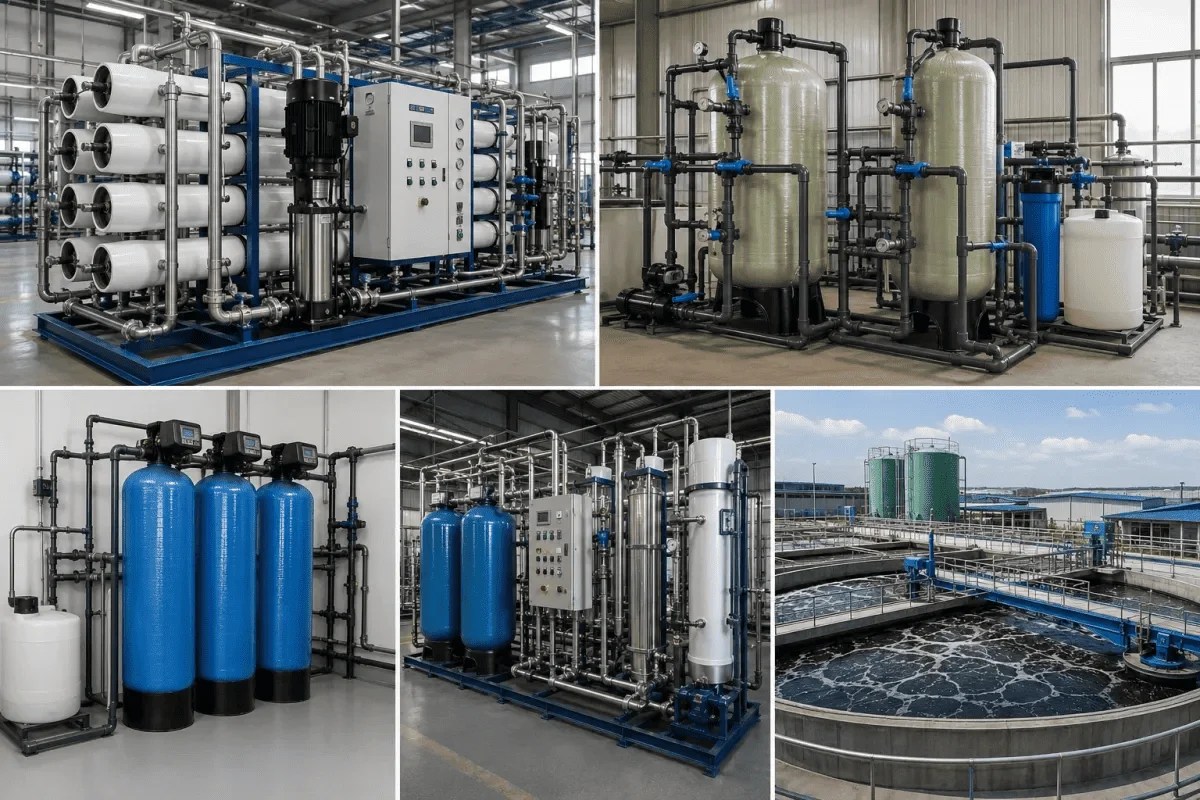
The names below describe either a main treatment objective or a major technology. A project may combine several of them.
Iron Removal Plant for groundwater staining and metallic taste
An Iron Removal Plant, or IRP, treats groundwater with excessive iron and, where designed for it, related manganese or odor problems. The usual process includes oxidation followed by filtration through suitable media.
An IRP can help reduce:
- Red or yellow staining
- Metallic taste
- Iron deposits in tanks and pipes
- Clogging linked to iron accumulation
But the phrase “iron removal plant” is not a complete specification. The service provider still needs the iron concentration, pH, manganese result, peak flow, and backwash-water availability.
Water Softener Plant for scale control
Hard water leaves scale inside heaters, boilers, pipes, and heat-transfer equipment. A Water Softener Plant reduces calcium and magnesium through ion exchange.
It is commonly used in hotels, laundries, boiler systems, factories, and buildings with a measurable hardness problem. You should check resin volume, service flow, regeneration frequency, salt consumption, and hardness leakage after treatment.
Reverse Osmosis Plant for high dissolved solids
RO is useful when dissolved salts or particular dissolved contaminants must be reduced. It is used for drinking-water production, commercial operations, and industrial process water.
A complete RO plant usually needs more than a membrane and pump. Depending on the feed water, the system may require iron removal, softening or antiscalant dosing, activated carbon, cartridge filtration, pressure control, and post-treatment.
For smaller drinking-water requirements, SK Corporation also supplies RO water purifiers for home use. A household purifier and an industrial RO plant use the same core membrane principle, but their capacity, controls, pretreatment, and operating demands are not the same.
Demineralization Plant for high-purity process water
A Demineralization Plant, or DM Plant, removes dissolved ions through cation- and anion-exchange resins. It is used where low conductivity and tight mineral control are required, such as laboratories, power applications, and certain manufacturing processes.
DM plants require trained operation and chemical regeneration. For very demanding applications, mixed-bed polishing or another final stage may be added after the main demineralization process.
UV and UF systems for microbial and particle control
UV and UF are often mentioned together, but they work differently. UV inactivates microorganisms. UF creates a physical membrane barrier that retains fine particles and many microorganisms.
Neither technology should be sold as a universal answer. UV does not remove TDS, hardness, or iron. UF does not reduce dissolved salts like RO. Both need the correct pretreatment and operating conditions.
Central Drinking Water Plant for buildings and institutions
A central drinking-water plant serves several user points from one treatment and distribution arrangement. It can suit offices, factories, hospitals, schools, and apartment projects.
The design must account for peak use, treated-water storage, pump pressure, distribution distance, and hygiene inside the network. Producing good water at the plant is only half the job. That quality has to be protected until the water reaches each outlet.
Jar and small bottled-water treatment plants
Packaged drinking-water production involves treatment, hygienic storage, and a controlled filling environment. The plant may include multimedia filtration, carbon, RO, UV, ozone, or other stages based on the source and required output.
The treatment unit alone does not make the final packaged product safe. Bottle or jar washing, filling hygiene, storage, testing, and applicable approvals also need attention.
Effluent Treatment Plant for industrial wastewater
An ETP treats the wastewater generated by an industrial process before discharge or planned reuse. The process may involve physical separation, pH correction, chemical treatment, biological treatment, clarification, filtration, and sludge management.
Its design depends heavily on the industry and wastewater characteristics. Textile effluent, food-processing wastewater, and pharmaceutical effluent cannot be treated as one identical stream.
Which Technology Treats Which Problem?
Instead of asking, “Which water treatment technology is the best?” ask this question: Which technology solves my specific water problem?
| Technology | Suspended particles | Iron | Hardness | TDS/salts | Microorganisms | Taste, odor, or chlorine |
| Multimedia filtration | Strong role | Limited unless paired with oxidation/media | No | No | Limited | Limited |
| Iron-removal filtration | Some | Strong role when correctly designed | No | No | No | Can help with iron-related taste/odor |
| Activated carbon | Some | Not its main role | No | No | Not a disinfection method | Strong role for certain compounds |
| Water softener | No | Limited and condition-dependent | Strong role | Does not reduce total salts like RO | No | No |
| UF | Strong role for fine particles | Needs pretreatment | No | No | Strong membrane barrier role | No |
| UV | No | No | No | No | Inactivation role | No |
| RO | Needs pretreatment | Needs pretreatment | Reduces many dissolved ions, but scale control is needed | Strong role | Membrane barrier plus suitable hygiene controls | Can improve taste depending on cause |
| DM | Needs pretreatment | Needs pretreatment | Removes ions | Strong high-purity role | Not its main purpose | No |
Notice the pattern? These technologies are not competing in a simple “best versus worst” contest. They solve different problems.
The right question is not whether RO is better than a softener or whether UF is better than UV. The right question is whether the treatment process matches your water.
Match the Water Problem Before You Buy the Equipment
| Test result or symptom | Likely treatment direction | What must still be confirmed |
| High iron with red staining | Oxidation plus iron-removal filtration | Iron form, concentration, pH, and manganese |
| High hardness with white scale | Water softener | Hardness load, peak flow, and regeneration plan |
| High TDS or salinity | RO with suitable pretreatment | Feed chemistry, recovery, pressure, and reject disposal |
| High turbidity | Clarification, multimedia filtration, or UF | Particle load and seasonal variation |
| Microbial contamination | Pretreatment plus validated disinfection | Turbidity, dose, contact time, storage, and distribution |
| Arsenic above the applicable value | A validated arsenic-removal process | Arsenic level/speciation, competing ions, and treated-water test |
| Chlorine taste or certain organics | Activated carbon | The actual cause and media contact time |
If your laboratory report shows iron, hardness, and high TDS at the same time, do not expect one tank filled with one type of media to solve everything.
You may need iron removal, scale control, and RO in a specific sequence.
Plant Requirements Change With the Application
A home and an apartment building are not the same project
A family may need a point-of-use purifier for drinking and cooking. An apartment building may want treated water for bathing, laundry, and all domestic points, plus a separate drinking-water arrangement.
Before comparing systems, decide what percentage of the water actually needs drinking-water treatment. Treating every litre through RO can be unnecessary in many domestic projects.
Offices and institutions experience sharp demand peaks
An office may have modest use throughout the day and a sudden rush during breaks. Schools, hospitals, and mosques also have distinct peak periods. Average daily use alone can understate the required flow or storage.
Hotels and restaurants often need more than one water quality
Drinking, cooking, laundry, hot-water systems, and cooling equipment do not always need the same treatment. Separating the streams can reduce both capital and operating costs.
Industrial water starts with the process specification
Factories need to define where the water will go. Boiler feed, cooling towers, washing, product formulation, and staff drinking points can each require a different quality.
How to Calculate Water Treatment Plant Capacity
When you compare plant capacities, make sure you know exactly what the number represents.
Plant capacity should describe the usable treated-water output, not only the amount of water entering the system.
Start with these seven factors:
- Total water required per day
- Hours the plant will operate
- Peak hourly demand
- Required treated-water storage
- Recovery or production efficiency
- Water used for backwash and regeneration
- Expected future growth
Suppose a facility needs 12,000 litres of treated water each day and wants the plant to run for eight hours. The simple average output is:
12,000 litres ÷ 8 hours = 1,500 litres per hour
That is only a starting point. If the process is RO, the feed flow will be higher than the permeate output because part of the water leaves as concentrate.
Backwashing and softener regeneration also consume water. Peak use may require a larger treated-water tank even if the hourly plant output stays the same.
LPH, GPD and cubic metres per day
- LPH: litres per hour
- m³/day: cubic metres per day, with 1 m³ equal to 1,000 litres
- GPD: gallons per day
Ask which gallon your supplier uses when converting GPD. A US gallon and an imperial gallon are not the same.
More importantly, confirm that the stated figure is treated-water production under your feed-water conditions, not a theoretical membrane label.
Water Treatment Plant Price in Bangladesh
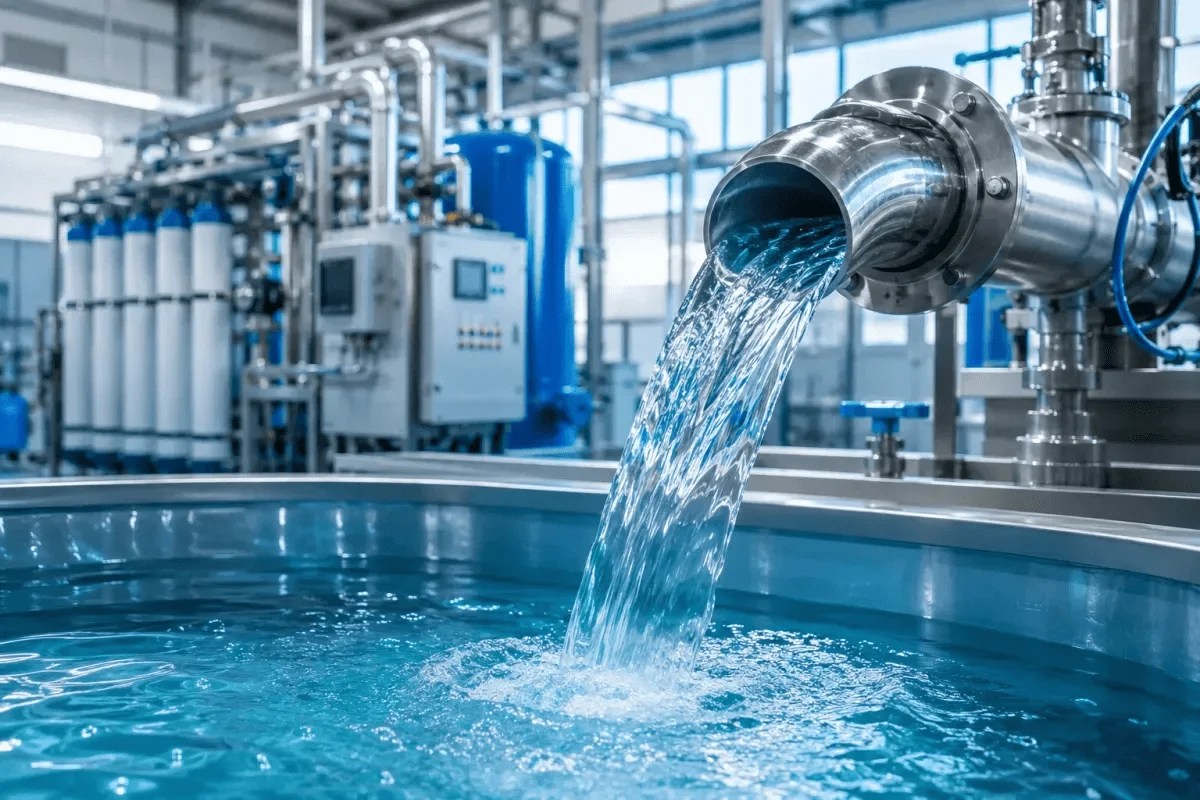
There is no universal single price for a water treatment plant in Bangladesh. Cost changes with raw-water quality, required output, treated-water capacity, component specification, automation, and project scope.
Two plants rated at the same LPH can have very different prices because their pretreatment, recovery, construction, and installation requirements differ.
The SK Corporation water treatment plant price may start around BDT 10,000, while larger or specialized systems can exceed BDT 100,000. We recommend contacting our team to get the actual price for your specific plant.
What changes the price?
- Raw-water test results
- Required treated-water standard
- LPH or daily output
- Peak flow and storage
- Number and order of treatment stages
- Vessel, pump, membrane, and media specifications
- Construction material, such as FRP or stainless steel
- Manual, semi-automatic, or automatic controls
- Dosing equipment and instruments
- Tanks, distribution pumps, and control panels
- Piping, drainage, civil, and electrical work
- Transport, installation, and commissioning location
- Redundancy or future expansion
Equipment price is not always the installed price
One quotation may include only the main equipment. Another may include tanks, piping, wiring, installation, commissioning, and operator training. The lower number is not automatically the lower project cost.
Ask your supplier to state the exclusions. Common exclusions can include:
- Laboratory testing
- Raw and treated-water tanks
- Civil base or plant room
- Main electrical connection
- Drainage work
- Interconnecting pipes outside the skid
- Transport outside a stated area
- Tax or government fees
- Initial chemicals, salt, or replacement cartridges
- Annual maintenance
We help you select the right equipment, plan the installation, and manage the treatment process. Please contact us to discuss your requirements and get a suitable solution for your project.
Look beyond the purchase price
The plant continues to cost money after installation. Electricity, reject water, backwashing, salt, chemicals, cartridges, media, membranes, testing, and service all form part of the lifecycle cost.
An inexpensive plant with poor pretreatment can consume membranes quickly. An oversized pump can waste electricity. An undersized filter may need frequent backwashing and still fail during peak demand. That is why a clear design basis is more valuable than the lowest quotation you receive.
Check the Site Before the Plant Arrives
Even a technically sound design can become a difficult project if the site is not prepared properly.
Before installation, confirm that you have:
- Enough floor space for equipment and future service
- A stable foundation and suitable floor load
- Raw-water and treated-water tank positions
- Pipe routes and correct connection sizes
- Drainage for backwash, RO concentrate, and cleaning water
- Electrical supply, protection, and earthing
- Ventilation and weather protection
- Safe chemical or salt storage
- Access for media, membrane, and pump replacement
- A hygienic treated-water storage arrangement
Do not place filters so tightly against a wall that technicians cannot open valves or remove internal components. A little extra space during installation can save you significant time and disruption during every future maintenance visit.
What a Proper Installation Process Looks Like
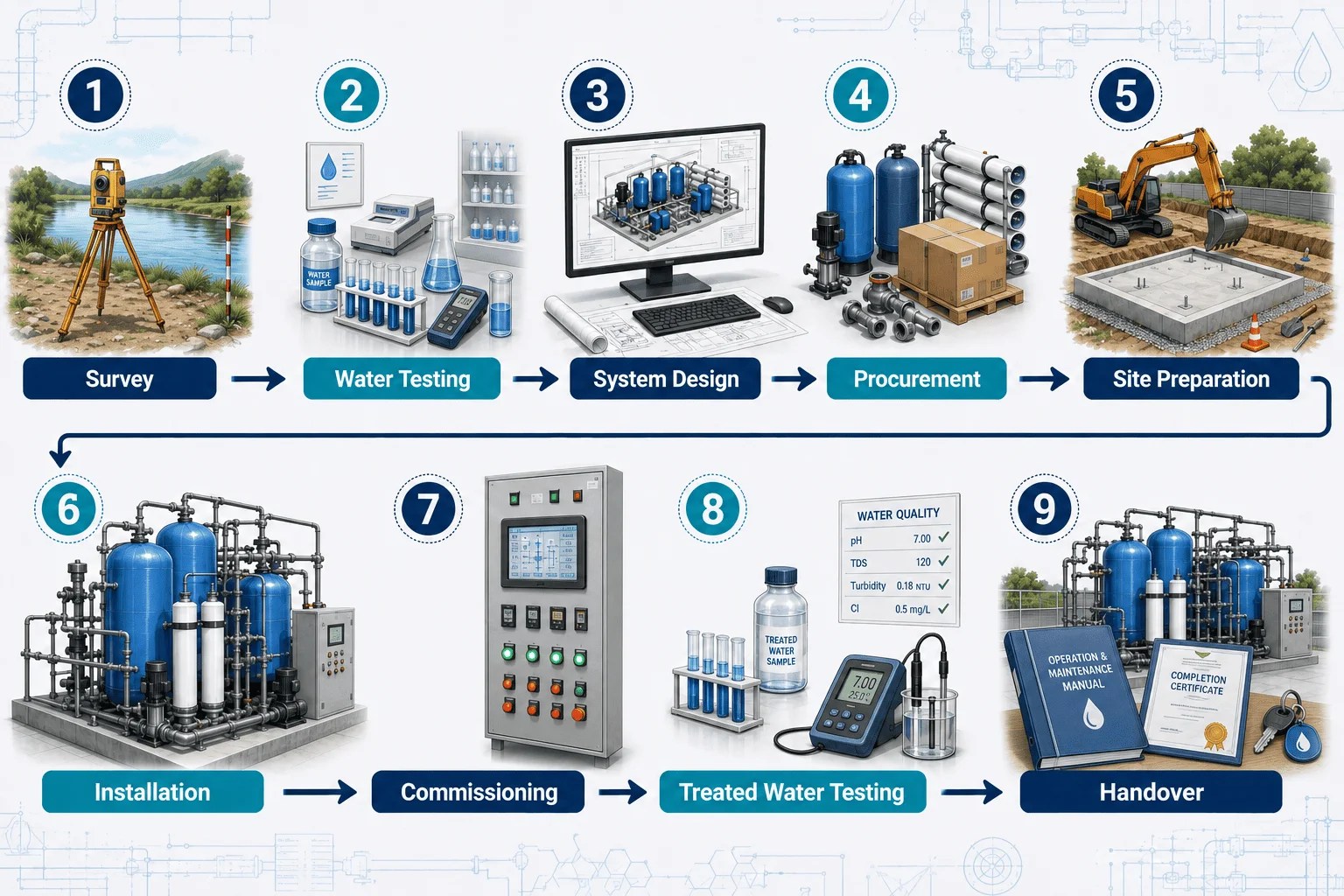
A professional water treatment project should move through a clear sequence. The exact process can vary, but you should expect something close to this:
- Requirement discussion: source, use, capacity, and existing problems
- Site survey: space, tanks, pipes, power, drainage, and access
- Water sampling and analysis: representative raw-water data
- Output definition: the treated-water quality the plant must reach
- Process and capacity design: treatment sequence, flow, and storage
- Proposal and scope confirmation: components, inclusions, and exclusions
- Fabrication or procurement: equipment prepared to the agreed specification
- Site preparation: civil, plumbing, and electrical work
- Installation: mechanical and electrical integration
- Commissioning: flushing, setting flows, checking pressure, and operating the plant
- Treated-water testing: confirmation against the agreed output
- Training and handover: operating instructions, service plan, and documents
Water flowing from the outlet does not prove that the plant is working correctly. Proper commissioning and treated-water testing give you evidence that the system is achieving the agreed target.
Compare Quotations Line by Line, Not Total Against Total
Before accepting a proposal, ask:
| Question | Why it matters |
| Is the quotation based on the same raw-water report? | Different assumptions produce different plants |
| Is capacity feed flow or treated-water output? | The numbers can differ significantly |
| What treated-water specification is promised? | “Clean water” is not measurable |
| Are media quantities and component models listed? | A plant name alone does not define its build |
| What is included in installation? | Tanks, wiring, and piping may be excluded |
| How much reject or backwash water is expected? | Drainage and operating cost depend on it |
| What consumables will be needed? | Maintenance cost starts after handover |
| Is commissioning and treated-water testing included? | Performance needs verification |
| What does the warranty cover? | Equipment and consumables may have different terms |
| Who provides after-sales service? | A plant needs support beyond the sale |
A proper proposal should also state design assumptions. If raw-water quality later moves outside those assumptions, the treatment result may change. That is not fine print. It is a normal engineering limit that should be clear from the start.
How to Assess a Water Treatment Plant Supplier
Look for evidence that the supplier can manage the complete job, not just sell tanks and pumps.
Look for evidence of:
- Similar completed projects
- Ability to explain the water report in plain language
- A clear process flow and component schedule
- Transparent capacity and output assumptions
- Site survey and installation support
- Commissioning and treated-water testing
- Local access to filters, membranes, and spare parts
- Written warranty and service terms
- Operator training and maintenance guidance
Be particularly careful if every customer receives exactly the same configuration regardless of their water report.
Also be cautious when someone promises “100% pure water” without defining what that actually means or explaining how performance will be tested.
Why Choose SK Corporation for Water Treatment in Bangladesh?
SK Corporation has more than 24 years of experience and more than 4,000 completed projects. We help you identify the water problem, select the appropriate treatment process, install the system, and support its ongoing operation and maintenance.
Our water treatment solutions include:
- Residential Water Treatment
- Industrial Water Treatment
- RO Plant (Reverse Osmosis Plant)
- Effluent Treatment Plant (ETP)
- Sewage Treatment Plant (STP)
- Iron Removal Plant (IRP)
- Water Softener Plant (WSP)
- Central Drinking Water Plant
- Demineralization Plant (DM)
- Jar Water Treatment Plant
- Small Bottled Water Treatment Plant
- Repair & Maintenance Services
If you need a new water treatment plant or support for an existing system, our team can help you assess the requirement and determine the appropriate solution.
Maintenance Is Part of the Plant, Not an Extra
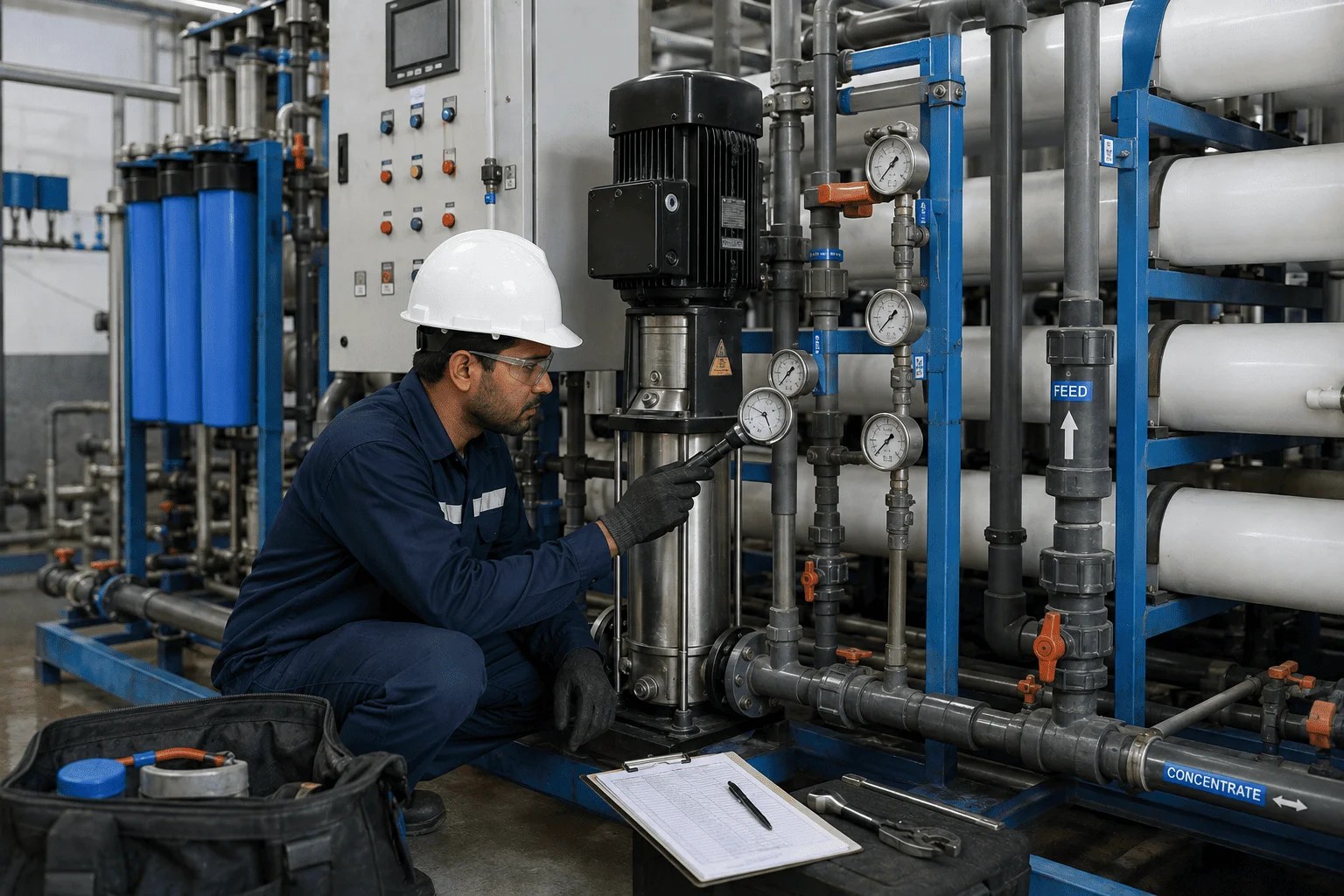
Every filter collects something. Every membrane operates under pressure. Pumps, valves, instruments, and chemical systems all change with use. So, even a well-designed WTP needs a maintenance plan.
Routine checks
Depending on the plant, you should monitor:
- Inlet and outlet pressure
- Flow rate
- Tank levels
- Leaks or unusual pump noise
- pH, conductivity, TDS, or hardness at defined points
- Chemical and salt levels
- Backwash or regeneration records
Periodic service work
Periodic work can include cartridge replacement, media inspection, softener regeneration review, RO performance testing, membrane cleaning, UV lamp and sleeve inspection, pump servicing, instrument calibration, and tank cleaning.
There is no honest universal statement such as “change every filter every six months.” Feed quality, operating hours, load, media quantity, and manufacturer requirements all affect the schedule.
Warning signs that deserve attention
- Output has fallen
- Pressure drop has increased
- Treated-water TDS is rising in an RO system
- Hardness appears after a softener
- Iron staining has returned
- Taste or odor has changed
- A pump cycles too frequently
- Reject water has increased unexpectedly
- Filters need backwashing much more often
- Leaks or media carryover are visible
Don’t hesitate if you see any warning signs in your water treatment plant. We provide water treatment plant repair and maintenance support for all kinds of water treatment plant systems.
Buying Mistakes That Cause Expensive Problems
Buying from TDS alone
TDS is one number. A treatment plant needs a contaminant profile.
Treating iron, hardness, and TDS as one problem
They are related to water chemistry, but they need different treatment mechanisms.
Installing RO without protecting the membrane
Iron, hardness, chlorine, and suspended material can shorten membrane life. Pretreatment is not decorative equipment.
Comparing theoretical capacity
Membrane production changes with feed TDS, pressure, temperature, and system condition. Ask about treated output under the design conditions.
Ignoring storage and peak demand
A plant can meet the daily total and still fail at lunch break, shift change, or morning peak.
Forgetting reject and backwash drainage
Water has to leave the plant during RO operation, backwashing, and regeneration. The site needs a planned route for it.
Skipping the final water test
The treated-water result is the evidence that the plant reached the agreed target at commissioning.
A Short Checklist for Your Water Plant
Before you order a water treatment plant in Bangladesh, make sure you have:
- Identified your raw-water source
- Collected a representative laboratory sample
- Defined the intended water use
- Defined the required treated-water quality
- Calculated daily demand
- Calculated peak demand
- Compared complete treatment processes rather than just plant names
- Confirmed treated-water output rather than only feed capacity
- Reviewed equipment specifications
- Reviewed installation scope
- Checked all exclusions
- Estimated electricity, water, and consumable costs
- Checked available space
- Checked electrical requirements
- Checked drainage
- Confirmed commissioning
- Confirmed treated-water testing
- Reviewed warranty terms
- Reviewed operator training
- Reviewed after-sales support
If several of these items are still missing, pause before you purchase. A short delay before ordering is easier to manage than rebuilding the treatment train later.
Frequently Asked Questions
Common questions about choosing, sizing, and maintaining a water treatment plant in Bangladesh.
How much does a water treatment plant cost in Bangladesh?
The price depends on the water report, treatment type, treated-water capacity, construction material, automation, and installation scope. At SK Corporation, small filtration systems may begin around BDT 10,000, but complete commercial and industrial plants can cost BDT 100,000 or more. We recommend contacting us and sharing your requirements so we can prepare a quotation for your plant.
Which water treatment plant is best for groundwater?
There is no single best groundwater plant. Tested iron may need oxidation and iron-removal filtration. Hardness may need a softener. High TDS or salinity may need RO. Arsenic requires a validated removal process. Groundwater with several problems normally needs a combined treatment train.
Is a TDS test enough to buy a water treatment plant?
No. TDS estimates the total dissolved-ion load but does not identify the individual ions or show iron, arsenic, turbidity, and microbiological risk properly. A representative laboratory analysis gives the designer the information needed to match the treatment process with the actual water.
What is the difference between an iron removal plant and a softener?
An Iron Removal Plant targets iron through oxidation and filtration. A softener targets calcium and magnesium hardness through ion exchange. Iron and hardness can occur in the same source, but one system does not automatically perform the complete job of the other.
Does every water treatment plant need RO?
No. RO is valuable when dissolved salts or specific dissolved contaminants must be reduced. Water with low TDS but high turbidity or microbiological risk may need filtration and disinfection instead. Unnecessary RO can increase energy use, reject water, and maintenance.
What is the difference between RO and a DM plant?
RO separates a large portion of dissolved salts through a pressure-driven membrane. A DM plant removes ions through cation- and anion-exchange resins. DM is often used for high-purity industrial applications, while RO is common in drinking-water and process-water systems. Some high-purity designs use both.
Can UV remove iron, hardness, or TDS?
No. UV is a disinfection technology. It inactivates microorganisms under the correct operating conditions but does not remove iron, hardness minerals, or dissolved salts. Those problems need separate treatment before or alongside UV.
How is WTP capacity calculated?
Capacity begins with daily demand divided by operating hours, then adjusts for peak use, plant recovery, backwash, regeneration, storage, and future growth. For RO, confirm that the quoted LPH refers to permeate output under the stated feed-water conditions.
How much space does a WTP need?
Space depends on capacity, number of treatment stages, tank arrangement, and service access. The equipment footprint alone is not enough. Leave room to operate valves, remove membranes, replace media, service pumps, and store treatment chemicals safely.
How often should a water treatment plant be serviced?
The schedule depends on raw-water quality, operating hours, flow, treatment process, and component manufacturer. Pressure, flow, and basic quality indicators should be monitored routinely. Filters, media, membranes, UV parts, and pumps should be serviced according to measured condition and the plant’s maintenance plan.
How do I know the plant is working correctly?
Monitor operating pressure and flow, then test treated water for the parameters the plant was designed to control. A clear appearance is not enough. Commissioning results and periodic laboratory tests provide better evidence that the required output is being maintained.
Let’s Find the Right Water Treatment Solution for You
Tell us about your water source, required capacity, and intended use. Our team can help you choose the right treatment process and plan your installation.
Talk to Our Water Treatment Experts
Most people think tap water from WASA is safe to drink, but that is not always the case. Water in Dhaka often has a TDS of around 210 mg/L, which can make it taste slightly salty. Even if the water looks clear, tiny particles and microbes can still be present.
Some water samples show coliforms and E. coli above safe levels set by the WHO and Bangladesh standards. This makes relying solely on tap water risky, especially for children, older adults, and people with weaker immunity.

Chemicals, Metals, and Sediment Found in WASA Water
You may notice a metallic taste or unusual odor in WASA water sometimes. Dissolved salts, chlorine, iron, and other particles are usually responsible. TDS around 210 mg/L can slightly affect taste and reduce the efficiency of some purifiers. Chlorine gives water a bitter taste and odor, while sediment can clog filters and slow water flow.
Iron can leave stains on sinks or give water a metallic flavor. Microbes such as coliform bacteria can survive the treatment process, which makes extra purification important.
| Parameter | Typical Level in WASA Water | Effect on Health / Taste |
| TDS | 210 mg/L | Slightly salty taste; affects RO efficiency |
| Chlorine | 0.3–0.8 ppm | Bitter taste, odor |
| Sediment | Occasionally visible | Clogs filters, reduces flow |
| Iron | 0.2–0.5 mg/L | Stains, metallic taste |
| Microbial (Coliform / E. coli) | Detected in some samples | Potential health risk; needs UV/UF |
Filters Needed for WASA Water Purifiers

WASA water has multiple contaminants, so one filter cannot handle everything. Each stage has a specific purpose to make water safe and clean.
- The sediment filter removes sand, rust, and visible particles.
- Carbon filter removes chlorine and odor, improving taste and protecting the RO membrane.
- RO membrane removes dissolved solids, heavy metals, and reduces high TDS.
- UV or UF filter kills bacteria, viruses, and other microbes.
- Post-carbon or mineral filter restores essential minerals and enhances taste.
The correct combination of these filters ensures safe drinking water. This also protects your home appliances and keeps your purifier running efficiently.
Best Water Purifiers for WASA Water in Bangladesh
Some purifiers are better suited for WASA water than others because they handle TDS, chlorine, sediment, and microbes effectively.
| Brand / Model | Stages | Filter Life | Capacity | Price Range | Notes |
| SK Tech RO 501 | 7 | 6–12 months | 8–10 L | BDT 15,000–18,000 | Suitable for high TDS water |
| Heron Max-Pro | 5 | 6–12 months | Hot 1 Liter, Normal 4Liters | BDT 15,000–17,000 | Includes Hot & Normal Water Options |
| Heron GRO-2300-S | 5 | 6–12 months | 8 L | BDT 20,000–25,000 | Compact for apartments |
These purifiers combine multiple filter stages to remove chemicals, metals, and microbes. They improve water taste, reduce health risks, and work well for home or office use.
Maintenance Tips for WASA Water Purifiers
Regular maintenance keeps your purifier effective. How often you check or replace filters depends on your area’s water quality.
- Monthly: Wipe the body, clean the tap, and check for leaks.
- Every 6–12 months: Replace sediment and carbon filters.
- Every 2–3 years: Replace the RO membrane.
- Annual: Sanitize the storage tank to prevent bacterial growth.
Following the maintenance steps ensures long filter life and a smooth-flowing purifier. Your family can enjoy fresh WASA water every day without worrying about taste or safety.
Common Problems with WASA Water Purifiers and Solutions

Even high-quality purifiers may face issues due to water quality or improper care. Awareness of these problems keeps water safe and appliances in good condition.
| Problem | Cause | Solution |
| Slow flow | Clogged sediment filter | Rinse or replace the filter |
| Chlorine taste | Exhausted carbon filter | Replace the carbon filter |
| Bad odor | Stagnant water in tank | Clean tank, flush system |
| Noise | Pressure issue or pump | Call technician |
You prevent damage and keep your water clean and safe when you act early. Proper care also saves you money on service and repairs.
Capacity Recommendations and Installation Tips for Homes and Offices
Capacity choice depends on family size, office usage, and daily consumption. Small families need 6–8 liters, medium families or small offices do well with 8–10 liters, and large offices require 10–15 liters.
Check the TDS meter after installation to confirm water quality. Place the purifier in a clean area away from direct sunlight or dust. Keep taps and filters accessible for maintenance.
Proper installation ensures smooth flow and purifier efficiency. It also makes maintenance easier and avoids unnecessary repairs.
Conclusion: Safe Drinking Water from WASA Water
You keep WASA water safe and tasty when you choose the right purifier and follow proper care steps. Knowing what chemicals, metals, and microbes are present helps you make informed decisions.
Filter replacements at the right time and careful handling protect your family and appliances. A high-quality purifier gives you peace of mind and safe drinking water every day.

Clean, safe drinking water starts with a well-maintained water purifier in your home. Every time you turn the tap, you expect fresh water for your family. As days pass, purifier filters capture dirt, chlorine, and other unwanted substances from the water supply.
When maintenance is ignored, filtration efficiency slowly drops, and water quality may not remain at its best.
Regular maintenance helps your purifier continue working properly. Clean filters improve the taste of water, protect the RO membrane, and maintain proper water flow.
At SK Corporation, we install and maintain RO water purifiers for homes, offices, and commercial spaces across Bangladesh. From our experience servicing thousands of units, one thing becomes clear: simple maintenance habits can add years to the life of a purifier.
This guide walks you through the essential steps you can follow at home. You will learn when to clean your purifier, how often filters should be replaced, and when our technicians should step in to help.

Why RO Water Purifier Maintenance Is Important
Your RO purifier removes many types of contaminants from the water supply. Sediment, chlorine, dissolved solids, and heavy metals get trapped inside different filtration stages. Over time, these filters start to fill up.
When filters clog, water flow slows down and purification performance drops. The purifier still runs, but it may not remove contaminants effectively. That is why maintenance plays a big role in keeping water safe.
Proper care also protects the most important component of the system: the RO membrane. This membrane performs the main purification process, and replacing it can be expensive. Clean pre-filters protect the membrane from damage and help it last longer.
Regular maintenance also helps you avoid unnecessary repair costs. A small leak, clogged filter, or pressure issue can turn into a larger problem if ignored.
How an RO Water Purifier Works at Home
Most household RO purifiers use a multi-stage purification process. Each stage removes a specific type of impurity before water reaches the storage tank.
Water first enters the sediment filter. This stage traps sand, rust particles, and other visible impurities coming from pipelines or tube wells.
The next stage is the activated carbon filter. Carbon removes chlorine, bad odor, and chemical contaminants that affect taste.
After that, water passes through the RO membrane. This stage removes dissolved solids, salts, heavy metals, and many harmful contaminants.
Finally, the water passes through a post filter before entering the storage tank. This stage improves taste and adds the final polishing step before the water reaches your glass.
Most RO purifiers installed by SK Corporation follow this filtration structure because it performs well with the typical water conditions found in Bangladesh.
| Filtration Stage | Main Purpose |
| Sediment Filter | Removes sand, rust, and dirt particles |
| Carbon Filter | Removes chlorine, smell, and chemicals |
| RO Membrane | Removes dissolved solids and heavy metals |
| Post Filter | Improves taste and final purification |
Recommended Filter Replacement Schedule
Every purifier needs filter replacement after a certain period. Water quality, usage, and the purifier model all affect how long each filter lasts. The table below shows a general filter replacement schedule you can follow.
| Filter Type | Replacement Time | Purpose |
| Sediment Filter | 6–12 months | Removes dirt, rust, and particles |
| Carbon Filter | 6–12 months | Removes chlorine and odor |
| RO Membrane | 2–3 years | Removes dissolved contaminants |
| Post Filter | 12 months | Improves taste |
Homes using tube well water may need more frequent replacement because sediment levels can be higher. WASA water may affect carbon filters faster due to chlorine. Our technicians usually check water conditions before recommending the correct replacement schedule for your purifier.
Steps to Clean Your RO Water Purifier at Home

Cleaning the purifier occasionally helps maintain hygiene and ensures smooth operation. Basic cleaning can be done safely at home if you follow the correct steps.
- Turn off the water supply and unplug the purifier before opening any component.
- Wipe the exterior body using a damp cloth to remove dust and grease.
- Empty the storage tank before cleaning the interior.
- Use a mild vinegar and water mixture to wipe the inside of the tank.
- Remove accessible filters and rinse them gently under clean running water.
- Avoid strong chemical cleaners near the water outlet or storage tank.
- Reassemble the system carefully after cleaning.
- Flush two to three liters of water before drinking.
This process helps remove mild deposits and keeps the purifier hygienic. If the purifier has complex internal tubing or electrical components, professional cleaning becomes safer.
Simple Filter Cleaning Tips for Home Users
Some filters can be rinsed occasionally to remove accumulated dirt between replacement periods. This helps maintain better flow and slightly extends the filter life.
- Look at tubing connections and valves to check for small leaks.
- Observe the water flow speed at the tap because slow flow often signals clogged filters.
- Pay attention to taste changes because carbon filters may need replacement.
- Inspect the storage tank area to ensure there is no moisture buildup.
- Keep the dispenser tap clean so dirt does not enter during water collection.
- Watch for unusual pump noise because pressure issues can affect performance.
These small checks take only a few minutes and help prevent larger problems later.
Signs Your RO Purifier Needs Service
Your purifier usually gives warning signs when maintenance becomes necessary.
Slow water flow often appears when sediment filters become clogged. The purifier may still run, but the tank fills slowly.
Changes in taste or smell can indicate exhausted carbon filters. The chlorine smell sometimes becomes noticeable when the carbon stage stops working properly.
Noise from the pump may indicate pressure problems or blockage inside the system.
Water leakage around the purifier or under the sink should always be checked immediately.
These signs usually mean the purifier needs inspection. Quick service can prevent damage to the membrane and other components.
When Professional Service Is Necessary

Basic cleaning can be handled at home, but some maintenance tasks require professional expertise. Replacing the RO membrane, sanitizing internal tubing, or fixing pressure issues often needs proper tools and experience.
Professional technicians can also test water quality and check TDS levels to confirm whether the purifier is working correctly. These tests help determine if filters or membranes need replacement.
SK Corporation technicians provide installation, filter replacement, and full maintenance services for residential water purifiers across Bangladesh. Our technicians inspect the system, clean filter housings, replace worn components, and ensure the purifier produces clean drinking water.
Annual servicing is usually recommended even when the purifier appears to be working normally. Preventive maintenance helps detect hidden problems early and keeps the system running efficiently.
RO Water Purifier Maintenance Checklist
Regular maintenance keeps your RO purifier working at its best and ensures your family or workplace always has access to clean drinking water. Below is a simple routine that helps you avoid problems and extends the life of your purification system.
| Maintenance Task | Frequency |
| Clean exterior and tap | Monthly |
| Check pipes for leaks | Monthly |
| Rinse pre-filters | Every 1–3 months |
| Replace the sediment filter | 6–12 months |
| Replace the carbon filter | 6–12 months |
| Replace the post filter | 12 months |
| Replace the RO membrane | 2–3 years |
| Tank cleaning and sanitization | Once a year |
This schedule ensures your purifier consistently delivers safe drinking water. When maintenance or filter replacement is needed, SK Corporation is ready to help.
Ensure Long-Term Performance of Your RO Water Purifier
Your RO water purifier will continue to provide safe, fresh, and great-tasting water when you follow a simple maintenance routine. Regular cleaning, timely filter checks, and replacements help keep the system running efficiently.
SK Corporation is here to support you with expert installation, filter replacements, and professional maintenance across Bangladesh. With consistent care and our guidance, your purifier will reliably protect your family’s health and serve your home for many years.

Water is the foundation of life, but not all water from taps or wells is safe for daily consumption. Many households in Bangladesh face water with high Total Dissolved Solids, chemical pollutants, heavy metals, and microorganisms. Consuming such water regularly can affect long-term health.
RO, or Reverse Osmosis, is a technology designed to address these issues. It uses a fine membrane to separate pure water from contaminants, giving families and offices safe drinking water.
In this article, we will explain RO water purification, how it works, what features you should consider, and how to maintain your system for consistent performance. By the end, you will see why RO purifiers are trusted by millions.

How RO Removes Chemicals, Heavy Metals, and Microorganisms
RO purifiers do more than simple filtration. They block harmful substances invisible to the eye.
Key contaminants removed by RO:
- Lead, arsenic, and mercury, which can affect nerves and organs
- Excess salts and dissolved solids affect taste and safety
- Bacteria, viruses, and other harmful microorganisms
- Chemical pollutants from industrial and household sources
RO water ensures every sip is safe. It also improves taste, making water better for drinking and cooking.
The Step-by-Step Process That Makes RO Water Safe
RO systems have multiple stages, each critical for pure water.
- Sediment Filter: Removes dust, sand, and rust. Protects downstream filters.
- Activated Carbon Filter: Removes chlorine, chemicals, and bad taste. Protects the RO membrane.
- RO Membrane: Filters dissolved salts, heavy metals, and chemicals. Produces purified water and wastewater.
- Post-Carbon Filter: Improves taste and ensures freshness.
- Storage Tank and Delivery: Safe storage and easy access to water.
How RO Water Removes Some Minerals and How It is Balanced
RO systems remove some minerals along with contaminants. While this ensures safe water, it also reduces certain natural minerals like calcium and magnesium. These minerals are important for health, so modern RO purifiers include a mineral cartridge.
The mineral cartridge restores essential minerals to water, maintaining a natural balance. This means your water is safe and healthy without losing taste or nutritional value. Families with children, elderly members, or people with specific dietary needs can benefit from this added feature.
Using RO Water for Cooking, Beverages, and Plants
RO water is suitable for cooking, beverages, and everyday consumption. Using RO water for cooking ensures that food retains its natural flavor without the interference of chlorine or chemical contaminants.
For plants, RO water is safe, but slightly mineralized water is preferable for optimal growth. High-quality RO systems with mineral cartridges provide water that supports both human health and plant care.

How Often Should Filters and RO Membrane Should Be Checked and Replaced
Maintenance is critical for ensuring consistent water quality. Sediment and carbon filters typically need replacement every six months, depending on usage. The RO membrane generally lasts two to three years, but should be monitored for efficiency.
The storage tank should be sanitized at least once a year. Regular maintenance prevents bacterial growth, ensures proper flow, and maintains water quality. SK Corporation provides clear guidance on replacement schedules and high-quality replacement filters for every system.
How RO Systems Handle Waste Water and Save Water
RO purifiers do produce some wastewater during filtration. The water that passes through the RO membrane as waste carries the concentrated impurities removed from the water. Modern RO systems minimize water loss and increase efficiency.
Some advanced RO systems allow the reuse of wastewater for cleaning or gardening. Even small reductions in water wastage make a big difference in water conservation at home or in offices.
TDS in Water and How RO Brings It to Safe Levels
Total Dissolved Solids (TDS) measures salts and minerals in water. High TDS can affect taste and long-term health. RO reduces TDS to 50–150 ppm, making water safe and pleasant.
TDS Levels and Their Impacts
| TDS Level (ppm) | Water Quality | Health Consideration |
| 0–50 | Very Low | Can taste flat, minor mineral deficiency |
| 50–150 | Ideal | Safe and balanced for drinking |
| 150–300 | Acceptable | Slight taste issues, safe for most purposes |
| 300+ | Poor | May affect taste and long-term health |
SK Corporation RO Systems: Advanced Technology for Clean Drinking Water
SK Corporation RO purifiers combine safety, convenience, and advanced technology. Our systems remove contaminants while maintaining essential minerals. Smart storage tanks ensure water availability even during power cuts, and energy-efficient designs reduce electricity use.
The systems are designed for easy installation and minimal maintenance, providing families and offices with long-lasting performance. Our RO purifiers are built for daily use, giving you clean, fresh, and safe water consistently.
How to Test Your Water Source Before Installing RO
Testing your water helps you identify any salts, chemicals, or microorganisms that could affect your health or the performance of the RO system. Simple tests can give you a clear picture of what your water contains, and this information will help you select the right purifier and storage capacity for your home or office.
- Measure TDS levels
- Check for chemical contaminants
- Identify bacteria or virus risk
- Decide storage capacity based on daily water usage
Extra Safety Tips:
- Use a TDS meter for accurate results
- Observe water color, odor, and taste
- Consider RO systems with UV or UF for extra protection
Tips for Maintaining Your RO System and Water Quality
A well-maintained RO system provides safe and fresh water consistently. Regular care prevents blockages, keeps the system running efficiently, and ensures the water remains free from contaminants. Simple steps help keep RO systems reliable:
- Clean pre-filters regularly
- Replace carbon and sediment filters on schedule
- Sanitize storage tanks annually
- Monitor TDS levels
- Keep taps and pipes clean
How RO Water Purifiers Improve Health and Lifestyle
RO water is safer for drinking, cooking, and beverages. It protects families from harmful chemicals, heavy metals, and microorganisms. Offices benefit by providing employees with clean water without worrying about contamination.
Lifestyle Benefit Includes:
- Better taste for water and beverages
- Reduced risk of waterborne illnesses
- Safe water for children and the elderly
- Consistent availability for everyday use

Conclusion
RO water purifiers have become an essential appliance for ensuring safe, clean, and healthy drinking water. They remove harmful chemicals, heavy metals, and microorganisms while providing fresh-tasting water. By understanding how RO works and choosing the right system, families and offices can have peace of mind every day.
At SK Corporation, we provide advanced RO solutions that are reliable, efficient, and easy to maintain. Investing in a high-quality RO purifier means investing in health and safety for your home or workplace. Clean water is no longer a luxury; it is a basic need, and RO makes it possible.

Water quality varies from place to place, and not every source provides safe water for daily use. Some water has too many dissolved salts, while other water may carry bacteria or particles that cannot be seen with the naked eye.
RO and UF are two widely used purification methods, but each addresses water problems differently. RO works best when water has high salt, chemical, or heavy metal levels. UF works well when water has bacteria or particles but low salt levels.
In this guide, we explain how RO and UF work, compare their strengths, and show when a combined system is the best choice. By the end, you will have clear information to decide which system fits your water source and lifestyle.

How RO Water Purifiers Remove Contaminants From Water
RO purifiers use a fine semipermeable membrane to remove contaminants. It blocks dissolved salts, heavy metals, chemicals, and microorganisms.
- Heavy metals removed: Lead, arsenic, mercury
- TDS control: Reduces Total Dissolved Solids for better taste
- Microorganisms: Remove bacteria and viruses
- Chemical pollutants: Pesticides and industrial chemicals
RO water is safe for drinking, cooking, and other daily uses. It also improves taste and odor.
How UF Water Purifiers Work and What They Can Remove
UF purifiers use a membrane to filter water, but do not remove dissolved salts. They are effective against bacteria, viruses, and larger suspended particles.
- Microorganisms removed: Bacteria and protozoa
- TDS removal: Not effective, dissolved salts remain
- Chlorine and odor: UF cannot remove chlorine, taste may remain the same
- Use case: Works well where water TDS is low and safe
UF is ideal for water with low dissolved solids, but may not be enough where TDS is hig,h or chemical contamination exists.
Differences Between RO and UF Water Purification
Here’s a simple way to understand the main differences:
| Feature | RO | UF |
| Dissolved solids removal | Yes | No |
| Bacteria and virus removal | Yes | Yes |
| Heavy metals removal | Yes | No |
| Chlorine removal | Yes | No |
| Electricity required | Yes | No |
| Wastewater produced | Yes | No |
| Suitable for high TDS water | Yes | No |
| Suitable for low TDS water | Optional | Yes |
Situations Where RO Water Purification is Better
RO is the preferred option in situations like:
- High TDS water sources: Well water, municipal supply with high salts
- Chemical contamination risk: Industrial areas or treated water supplies
- Heavy metals in water: Lead, arsenic, and mercury contamination
RO Benefits:
- Produces mineral-balanced, safe water with a cartridge
- Improves taste and odor significantly
- Can be combined with UV or UF for extra protection
- Provides stored water with smart tanks
Situations Where UF Water Purification Works Well
UF is ideal when water is already low in dissolved salts and safe from chemical contamination. Examples include:
- Municipal water with low TDS
- Rainwater harvesting systems
- Water sources with minor bacterial contamination
Advantages:
- Does not require electricity
- Minimal maintenance
- No water wastage
- Effective against bacteria and suspended solids
Can RO and UF Be Used Together?
Yes, combining RO and UF gives additional safety. Many modern purifiers use RO as the main filtration system and UF as a secondary stage.
- RO removes: TDS, chemicals, and heavy metals
- UF removes: Remaining bacteria and suspended particles
- Result: Safe, mineral-balanced, and fresh-tasting water

How Maintenance Differs Between RO and UF Systems
RO and UF have different maintenance needs:
RO Maintenance:
- Filters are replaced every 6 months
- RO membrane replaced every 2–3 years
- Storage tank cleaning annually
- Monitor TDS levels
UF Maintenance:
- Membrane cleaning periodically
- Minimal replacements, lasts 3–5 years
- No electricity needed, no wastewater
By following these maintenance routines, you can extend the life of your RO or UF system, maintain water quality, and ensure that every glass of water is safe and clean.
How to Decide Between RO and UF for Your Home
Before installing a system, consider these:
- Check your water source for TDS, chemicals, and contamination
- High TDS or chemical contamination requires RO
- Low TDS and minor bacterial contamination can be treated with UF
- Combined RO+UF is best for safety, mineral balance, and taste
Conclusion
Every household and office deserves water that is safe, clean, and reliable. RO provides protection when water has high salt, chemical, or heavy metal levels. UF works well when water has low salts, but may carry bacteria or particles.
For complete safety, a combined RO+UF system delivers both mineral balance and protection against impurities. SK Corporation offers these systems with smart storage, minimal maintenance, and consistent performance.